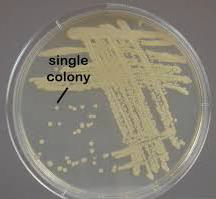
Results: streak plate method and pure cultures


Website: https://journals.physiology.org/doi/full/10.1152/advan.00167.2018?rfr_dat=cr_pub++0pubmed&url_ver=Z39.88-2003&rfr_id=ori%3Arid%3Acrossref.org 


Dr. Spencer: Well-done, you have isolated pure, single colonies! Now that we've isolated single colonies, what's our next step in studying these to identify the causative pathogen(s)?

Sam: First, we should observe the colonies themselves. We need to pay attention to characteristics like shape, size, color, and texture. These morphological traits can provide us with initial identification clues.

You: Absolutely, Sam. Observing the colony morphology may help us differentiate various bacterial types, even before performing other tests. 

Dr. Spencer: Good. After colony morphology, what about their cellular characteristics?

Sam: Next, we move to microscopy. We'll prepare either wet mounts or fixed smears to examine our bacterial cells under the microscope. This will allow us to see if they are rod-shaped or spherical.

You: We could then proceed with Gram staining the samples. It's a quick and effective way to differentiate bacteria into Gram-positive and Gram-negative categories.

Sam: Right, and that classification gives us a solid direction on narrowing down our potential pathogen candidates. Selective and differential media can also be used to further our study.

You: Precisely, and finally, after identification, conducting antibiotic susceptibility tests can determine the best treatment approach for the patient.

Dr. Spencer: Excellent summary. In this way, we can identify the pathogen(s) and tailor effective interventions.

  • Epilogue: Identification and Intervention

Map: CS11 - MICROBIAL CULTURE AND GROWTH (1052)
Node: 19836
Score:

reset

OpenLabyrinth
OpenLabyrinth is an open source educational pathway system

Review your pathway

  • Guidelines on how to write scientific lab reports
  • Experiment #1: Monitoring Algal Growth in Water Samples
  • Imaginea A este de la TEM, iar imaginea B este de la SEM
  • Invite him to join the PKU WhatsApp Support Group and set daily SMART goals.
  • La centrifugadora: procedimiento y seguridad
  • Safety
  • Não se importa e deixa as roupas no chão.
  • Ignore the warning signs.
  • Παρατήρηση στο μικροσκόπιο (ζωικό κύτταρο)
  • Do nothing the patient is disease-free
  • Send AVS without confirming understanding.
  • Summarize the points
  • Tell the patient to read the AVS alone without support.
  • Ele discute com a Callie.
  • Suggest antiseptic wash only.
  • Imaginea A este de la SEM, iar imaginea B este de la TEM
  • End without a summary
  • Βακτηριακό φορτίο
  • Delay referral until next week
  • Vai arrumar as roupas.
  • 50% πιθανότητα
  • Streak plate method and pure cultures
  • search for information online.
  • 25% πιθανότητα
  • Λύση σε απιονισμένο νερό, κανονικό σχήμα σε 0,9% NaCl και διόγκωση σε 6% NaCl
  • Observation of new experiment after three days.
  • 0% πιθανότητα
  • El espectrofotómetro
  • Rezultate: metoda cu lame de striație și culturi pure
  • Safety
  • Delay referral until next week
  • Lab report section 1
  • Ignore the warning signs.
  • Não se importa e deixa as roupas no chão.
  • Educate red-flag signs and refer immediately for an in-person visit
  • what happened next
  • Lab report section 2
  • Do nothing the patient is disease-free
  • Results: streak plate method and pure cultures

Reminder

empty_reminder_msg

FINISH

Time is up