Option 3

Prof. Wilson: Well-done! This is correct! Remember that a substrate is the specific reactant molecule upon which an enzyme acts. It binds to the enzyme's active site, where the chemical reaction occurs. The active site is the region on an enzyme where the substrate binds. It is typically a pocket or groove on the enzyme's surface and facilitates the conversion of the substrate into the product. The active site contains specific amino acid residues that interact with the substrate. Finally, a product is the molecule or molecules that result from the enzymatic conversion of the substrate. It is released from the enzyme after the reaction is complete. Who can give me an example?

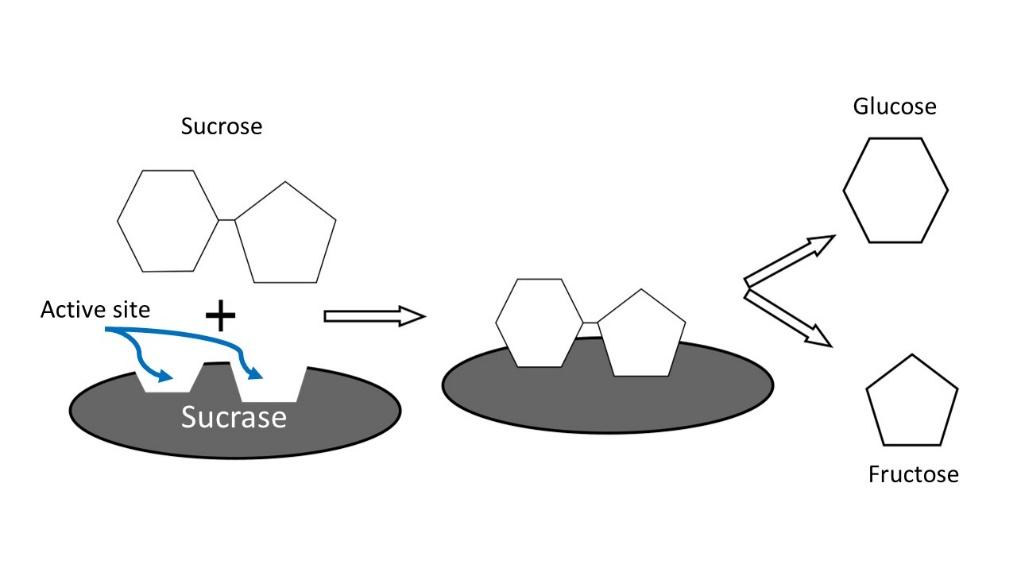
James: I remember the enzyme sucrase, which catalyzes sucrose, which is the substrate.  

You: That’s right, water is also utilized in the reaction, and fructose and glucose are the products of the reaction. The active site on the sucrase enzyme is specific for sucrose and no other substrates have the molecular structure to allow binding. 


Breakdown of sucrose (substrate) to fructose and glucose (product) catalysed by sucrase.

Website: https://commons.wikimedia.org/wiki/File:Sucrase.svg

You: Prof., how fast can an enzyme catalyze a reaction?

Prof. Wilson: Good question! Some key factors can affect the activity of the enzyme. Let’s see if you remember what we talked about in class this week.


Which factor can increase enzyme activity?

  • Increasing the temperature and the pH
  • Increasing the substrate concentration
  • Increasing the product concentration

Map: CS6 - METABOLISM OF CELL ENZYMES (PH/TEMPERATURE) (993)
Node: 18825
Score:

reset

OpenLabyrinth
OpenLabyrinth is an open source educational pathway system

Review your pathway

  • CELL STRUCTURE AND FUNCTION
  • Start
  • new node
  • Root Node
  • Usar solo la probabilidad mendeliana
  • go to espresso house
  • Discutir com a Callie.
  • Chief complaint
  • Screening and diagnosing glucose intolerance in pregnancy
  • Node 4: Move to the benefits of telemonitoring
  • A Thursday morning
  • Tele-Physical Examination
  • Start
  • Vital Sign
  • new node
  • Insulin
  • Give an immediate diagnosis without exploring the patient’s narrative.
  • History
  • Calcium: Increased; Potassium: Decreased; Sodium: Increased
  • Calcium: Decreased; Potassium: Decreased; Sodium: Decreased
  • Key Symptoms
  • Παραλείπει κάποιες ημέρες τη φαρμακευτική αγωγή
  • History of Allergies
  • Criminal Laboratory Internship
  • Υπολογιστικός Τομογράφος Διπλής Πηγής - Διπλής Ενέργειας
  • Solicitar un cariotipo
  • Μοριακή κλωνοποίηση
  • Physical Examination and Lab Tests
  • Επίσκεψη στο ιατρείο
  • Επιστροφή στο σπίτι
  • >Ο θόρυβος της εικόνας θα μειωθεί κατά 40%
  • Osmosis
  • new node
  • ΕΙΣΑΓΩΓΗ
  • The patient colapses
  • Dobutamine
  • Metabolism and Enzymes
  • The Telemedicine Dilemma
  • >Ο θόρυβος της εικόνας θα αυξηθεί
  • DNA Amplification
  • Methimazole
  • Empagliflozin
  • Metformin
  • Request permission to record without explaining privacy
  • Send him for f CT coron
  • Відмовитися від ліків, оскільки я вже почуваюся краще.
  • Past Medical History (PMH)
  • Jonah is 30 years old and lives with his mother in Thessaloniki.
  • Перевірити стан свого здоров'я без направлення лікаря.
  • Start
  • MICROBIAL CULTURE AND GROWTH
  • Παρουσίαση περιστατικού
  • Η κυρία A.Π. είναι μια γυναίκα 60 ετών με οστεοαρθρίτιδα στο χέρι.
  • Option 2: Only B is correct
  • Ігнорувати симптоми.
  • Όχι. Προσπάθησε ξανά!
  • Root Node
  • ΑΠΟΜΟΝΩΣΗ DNA ΚΑΙ ΑΛΥΣΙΔΩΤΗ ΑΝΤΙΔΡΑΣΗ ΠΟΛΥΜΕΡΑΣΗΣ (PCR)
  • lung auscultation
  • CELL CULTURE
  • Option 3
  • Δεν ακολουθεί τη συμβουλή της φίλης της
  • Presentation
  • Salbutamol
  • Building Trust and Teamwork in Digital Health Communication
  • Verify patient identity and obtain e-consent before starting.
  • Όχι. Προσπάθησε ξανά!
  • Ακολουθεί τη συμβουλή της φίλης της
  • visit the hospital
  • rewrerwe
  • Diffusion
  • 3 Fatima spends all day standing, so she doesn’t really need any kind of exercise
  • ΚΑΡΔΙΟΛΟΓΙΚΗ ΚΑΙ ΝΕΥΡΟΛΟΓΙΚΗ ΕΚΤΙΜΗΣΗ
  • Η Μαρία έχει πονόδοντο.
  • Εκτιμάτε το ανεπαρκώς σιτιζόμενο βρέφος
  • Option 2
  • Facem cunoștință cu laboratorul și cu ceilalți studenți
  • Επιχειρείτε να εισάγετε φλεβοκαθετήρα
  • Зачекати, коли настане черговий приступ симптомів та звернутися за медичною допомогою.
  • new node
  • Root Node
  • Assess the safety of the scene
  • ΜΕΝΔΕΛΙΚΗ ΓΕΝΕΤΙΚΗ ΚΑΙ ΠΡΟΒΛΗΜΑΤΑ
  • Σωστά! Προτεραιότητα και κύριος σύμμαχος σε κάθε διάγνωση αποτελεί μια ολοκληρωμένη λήψη ιστορικού από τον ασθενή.
  • Secvențierea genomului
  • B, C, E
  • Trăsături
  • Start
  • Omnom!
  • Definiția 1
  • Start
  • Permanently stop taking metformin
  • Genetica mendeliană și problemele genetice
  • Root Node
  • Getting worse
  • Pioglitazone
  • MĂSURI DE SIGURANȚĂ ÎN LABORATOR
  • DNA Isolation: Experimental reagents
  • Εκτιμάτε το βρέφος που έχει ίκτερο
  • Root Node
  • CELL DIVISION
  • Lysis buffers
  • Tamponul de liză
  • O pai diz ao filho.
  • Διερεύνηση
  • Option 3

Reminder

empty_reminder_msg

FINISH

Time is up