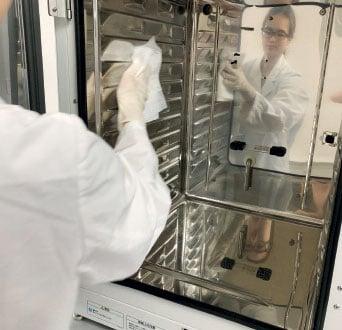
Decontamination and resetting the experimentDr. Lee gathers the group around the microscope to address the confirmation of contamination. Dr. Lee: ‘Now that we’ve confirmed contamination, our next step is to determine the extent and act accordingly. Here’s what we’ll do:’ 1. Assess Contamination Scope: Check all wells to see how many are affected. This will determine if some data is salvageable or if the entire plate needs to be redone. 2. Document Observations: Record contamination details—affected wells, type of contamination (e.g., cloudy media, debris), and how the cells were impacted. 3. Discard and Decontaminate: Dispose of compromised plates as biohazard waste and clean the incubator, hood, and tools thoroughly following lab protocols. 4. Plan Repeat Experiment: Review preparation steps and aseptic techniques to identify errors. Discuss improvements as a group and set up fresh experiments. 5.Add Sterility Controls: In the next experiment, include additional sterility checkpoints to catch contamination earlier and prevent it from affecting the study.
Dr. Lee: ‘Contamination is a common challenge in cell culture, and while it’s frustrating, it’s also an opportunity to learn. Let’s treat this as a chance to sharpen your aseptic techniques and troubleshooting skills. Once the lab is cleaned and prepared, we’ll get started on repeating the experiment.’
Dr. Lee oversees as the students begin clean the hood and the cell incubator decontaminating the work areas and preparing for the next steps.
LABRepCo How to properly clean incubators (https://www.labrepco.com/2022/09/07/how-to-properly-clean-cell-culture-incubators/)
Once this is completed they start seeding their cells to start the experiment again.
Go To |
Map: CS14 - CELL CULTURE_3 (1067)
|
||
|
Review your pathway |