Decontamination and resetting the experiment

Dr. Lee gathers the group around the microscope to address the confirmation of contamination.

Dr. Lee: ‘Now that we’ve confirmed contamination, our next step is to determine the extent and act accordingly. Here’s what we’ll do:’

1. Assess Contamination Scope: Check all wells to see how many are affected. This will determine if some data is salvageable or if the entire plate needs to be redone.

2. Document Observations: Record contamination details—affected wells, type of contamination (e.g., cloudy media, debris), and how the cells were impacted.

3. Discard and Decontaminate: Dispose of compromised plates as biohazard waste and clean the incubator, hood, and tools thoroughly following lab protocols.

4. Plan Repeat Experiment: Review preparation steps and aseptic techniques to identify errors. Discuss improvements as a group and set up fresh experiments.

5.Add Sterility Controls: In the next experiment, include additional sterility checkpoints to catch contamination earlier and prevent it from affecting the study.


Dr. Lee: ‘Contamination is a common challenge in cell culture, and while it’s frustrating, it’s also an opportunity to learn. Let’s treat this as a chance to sharpen your aseptic techniques and troubleshooting skills. Once the lab is cleaned and prepared, we’ll get started on repeating the experiment.’


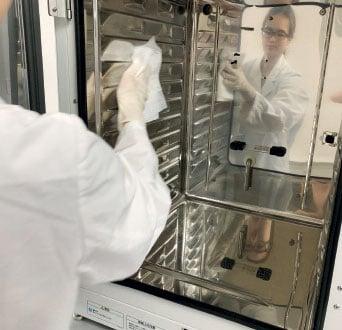
Dr. Lee oversees as the students begin clean the hood and the cell incubator decontaminating the work areas and preparing for the next steps.


lab professional cleaning cell culture incubator

LABRepCo How to properly clean incubators (https://www.labrepco.com/2022/09/07/how-to-properly-clean-cell-culture-incubators/)


Once this is completed they start seeding their cells to start the experiment again. 


Go To

  • Observation of new experiment after three days.

Map: CS14 - CELL CULTURE_2 (1066)
Node: 20143
Score:

reset

OpenLabyrinth
OpenLabyrinth is an open source educational pathway system

Review your pathway

  • It is part of the legislation to have labelled hazardous bottles with such symbols
  • Αποτελέσματα: μέθοδος διασποράς σε τρυβλίο και καθαρές καλλιέργειες
  • La imagen A es de TEM y la imagen B es de SEM
  • How is Alpha thalassemia diagnosed?
  • Definition 1
  • Getting better?
  • Babica spi.
  • Educate red-flag signs and refer immediately for an in-person visit
  • The reason
  • pH 8.0
  • Blood test for hemoglobin
  • what happened next
  • Lab report section 2
  • Liza în apă distilată, formă normală în soluție NaCl 0.9% și plasmoliză în soluție NaCl 6%
  • Preparación incorrecta del medio desprovisto de nutrientes
  • Results: streak plate method and pure cultures
  • Se necesitan muestras pequeñas e información sobre la estructura interna
  • Οι μεταβολές του pH μπορούν να οδηγήσουν στη μετουσίωση του αμύλου
  • pH 10.0
  • Getting better?
  • COPDAC (Cyclophosphamide, Vincristine/Oncovin, Prednisone, Dacarbazine)
  • Finally
  • Bacterial load
  • Το pH επηρεάζει τον ιονισμό του αμύλου
  • Send AVS without confirming understanding.
  • pH 3.0
  • 1/10
  • Blame the patient for poor network connection
  • Το pH επηρεάζει τον ιονισμό της αμυλάσης
  • The follow up
  • Summarize the points
  • Tell the patient to read the AVS alone without support.
  • Send short educational videos
  • Babica hodi po ulici.
  • 1/1000
  • Μόλυνση του μέσου ή κακή άσηπτη τεχνική
  • Λανθασμένη προετοιμασία του μέσου με έλλειψη θρεπτικών
  • Ask the family to take over all wound care without supervision
  • 10/10000
  • Ignore the warning signs.
  • 2
  • Αποτελέσματα: Επίδραση της θερμοκρασίας στη δραστικότητα της αμυλάσης
  • Finally
  • Απολύμανση και επαναφορά του πειράματος
  • 50% probability
  • Lab report section 3
  • Peter in oče se zabavata.
  • Η πλάκα δεν επωάστηκε στη σωστή θερμοκρασία ή επίπεδο CO₂
  • Finally
  • Decontamination and resetting the experiment

Reminder

FINISH

Time is up