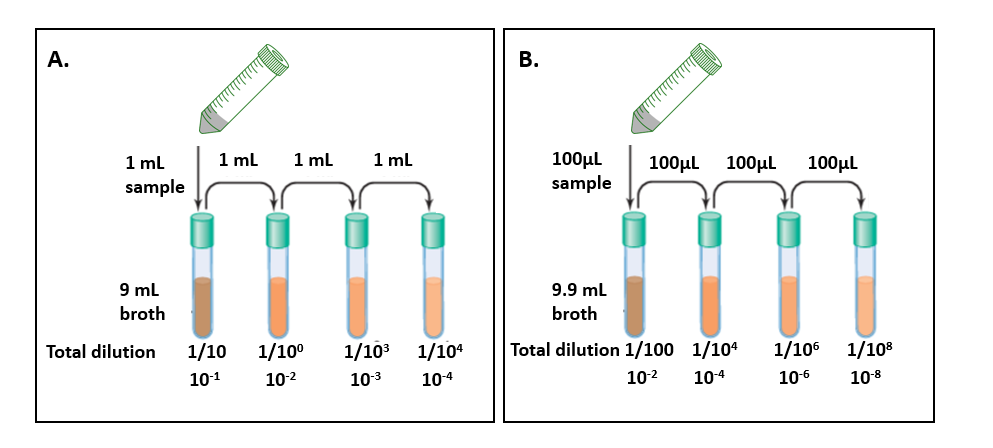
Quantification of bacterial load: Serial dilutionsDr. Spencer: To quantify bacterial load, we need to inoculate our samples on agar plates and count the individual colonies. Bacterial samples typically contain a very high number of cells. If these cells were to be plated directly, the resulting colonies would be too numerous to count accurately. You: We can perform serial dilutions so that we can reduce the concentration of bacteria to a level where individual colonies can be grown and easily counted. Dr. Spencer: That’s right! What dilutions do you think are more appropriate? Sam: For the more turbid samples (i.e. B and D) 4x100 dilution should suffice and we can use 4x10 dilution for the less turbid samples (A, C and E). You proceed to make the dilutions, as shown below and in the video. Website: Modified from https://loretocollegebiology.weebly.com/measuring-bacterial-growth.html
|
Map: CS11 - MICROBIAL CULTURE AND GROWTH (1052)
|
||
|
Review your pathway |