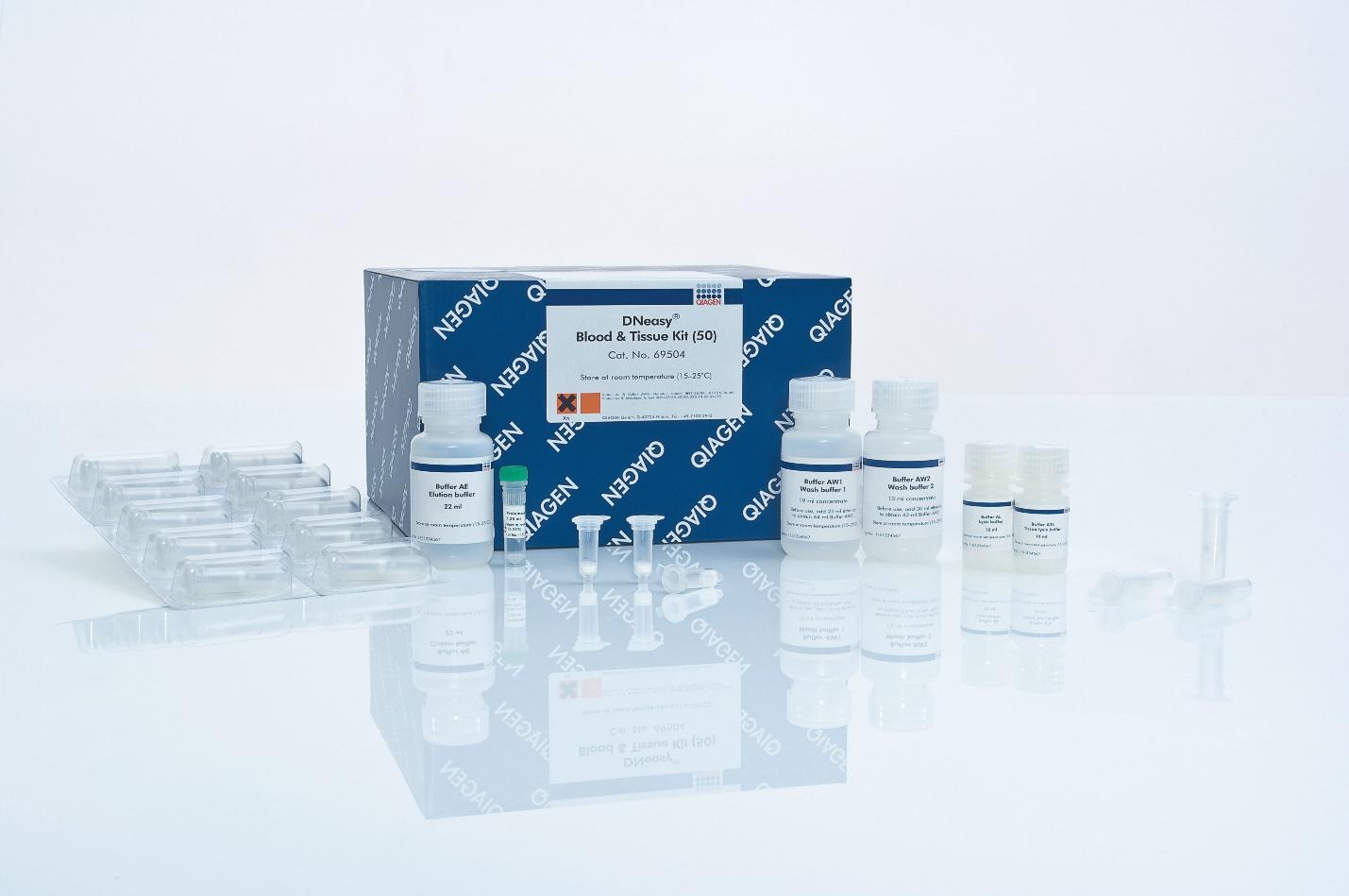
DNA Isolation: Experimental reagents

You are a final-year undergraduate student completing your thesis project in the laboratory of Dr. Demetriou. Dr. Demetrious’s work focuses on elucidating the pathophysiological mechanisms contributing to the development of heart failure. The work hopes that these insights will provide novel therapeutic targets. Your project focuses on studying the role of the newly-identified protein noveltin in cardiac function and dysfunction, using a transgenic mouse model. Your work will entail comparative experiments with control mice, which over-express the noveltin gene. 

It is very important that mice carrying the gene (experimental group) are appropriately identified and compared to mice with normal expression of noveltin (control group).  Your supervisor asks you to first isolate DNA from mouse tails and then carry out a polymerase chain reaction (PCR) to genotype the mice. 

You decide to use a DNA purification kit (QIAGEN), which is commonly used in your supervisor’s laboratory. 

https://www.qiagen.com/binary/resource/S_1405_RPA_DNY0900/1_5_WebFullSizeImage.jpg

Website: DNA purification kit (QIAGEN)

You look at the manufacturer’s instructions and note that a number of reagents are used including lysis buffers, proteinase K, ethanol, wash buffers, and an elution buffer. While the steps are clearly outlined, there is no information to explain the role of each reagent in the kit so you discuss this with your supervisor and he asks you which reagent is primarily responsible for denaturing proteins and aiding in the breakdown of tissues and cells.

  • Ethanol
  • Proteinase K
  • Lysis buffers
  • Wash buffer

Map: CS4 - ISOLATION OF DNA AND POLYMERASE CHAIN REACTION (PCR)_SPANISH (988)
Node: 18549
Score:

reset

OpenLabyrinth
OpenLabyrinth is an open source educational pathway system

Review your pathway

  • CULTIVO CELULAR
  • Surgical Referral
  • Glycerol trinitrate (organic nitrate)
  • Theophylline
  • El padre le dice a su hijo.
  • Start
  • Assess the safety of the scene
  • Verify patient identity and obtain e-consent before starting.
  • Salbutamol
  • Start
  • Request permission to record without explaining privacy
  • Dobutamine
  • Go to local cafe
  • Criminal Laboratory Internship
  • If you use antacids, it's better to use sodium bicarbonate
  • Glycerol trinitrate
  • Omalizumab/Salbutamol
  • Theophylline (methylxanthine)
  • If you use antacids, it is better to take them at least two hours apart of taking any other medication
  • Ignore the wound complaint and focus solely on blood glucose
  • Give an immediate diagnosis without exploring the patient’s narrative
  • Furosemide
  • go to a local cafe
  • Request permission to record without explaining privacy
  • Budesonide (glucocorticoid)/formoterol (LABA)
  • go to espresso house
  • Budesonide/formoterol
  • Inicio
  • Acknowledge the difficulty and shift gently to the patient’s condition
  • Allow the family member to stay on screen without clarifying their role
  • If you use antacids, it is better to combine them with alginates
  • Ask the victim how they are feeling
  • If you use antacids, it's better to use calcium carbonate
  • Call for someone to help
  • Grapefruit-thiazide interaction
  • Salbutamol (SABA)
  • Focus first on helping him learn the application
  • Amnestic exam
  • Stage 1 – Initial assessment
  • Omalizumab (IgE antibody)/Salbutamol (SABA)
  • Dobutamine (beta agonist)
  • Salmeterol (LABA)
  • Grapefruit-simvastatin interaction
  • Buy non prescribed anti-anxiety medication
  • Go to espresso house
  • Node 1: Introduction
  • DNA Isolation: Experimental reagents

Reminder

empty_reminder_msg

FINISH

Time is up