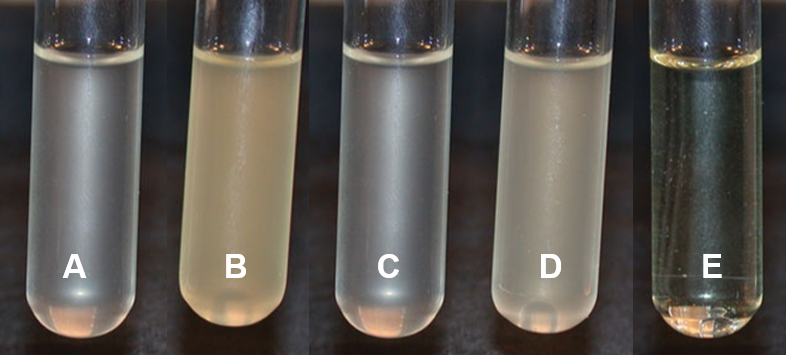
Results from liquid cultures.


A: Patient sample; B: Meat storage; C: Cutting board; D: Food preparation surface; E: Sink. 

Website: Modified from: chrome-extension://efaidnbmnnnibpcajpcglclefindmkaj/https://www.fbioyf.unr.edu.ar/evirtual/pluginfile.php/108402/mod_resource/content/1/Cap%205%20Brock.pdf 


You: I can see that there are different levels of cloudiness or turbidity, Dr. Spencer. And sample E appears clear. 

Dr. Spencer: That’s right, what do you think this means about the source(s) of contamination and bacterial load?

All areas tested are contaminated.
Areas B, C and D are contaminated and have a high bacterial load.
Areas B, C and D are contaminated.
Areas B and D are contaminated and have a high bacterial load.

Map: CS11 - MICROBIAL CULTURE AND GROWTH _ES (1054)
Node: 19874
Score:

reset

OpenLabyrinth
OpenLabyrinth is an open source educational pathway system

Review your pathway

  • Mechanism of action of GTN
  • MAC
  • new node
  • Results from liquid cultures.
  • Glomerular filtration rate
  • Ask rapid questions using medical jargon (ischemia, necrotic tissue, perfusion).
  • Observation
  • Παίρνετε τα αποτελέσματα των εργαστηριακών εξετάσεων και των ακτινογραφιών
  • Use open-ended questions and clarify priority symptoms (pain, discharge, fever).
  • History of Ischemic Stroke
  • Respond bluntly: “That is common in diabetes.”
  • EMB
  • Pelo
  • new node
  • What do these measures reveal?
  • Verapamil (calcium channel blocker)
  • Results from liquid cultures.

Reminder

empty_reminder_msg

FINISH

Time is up