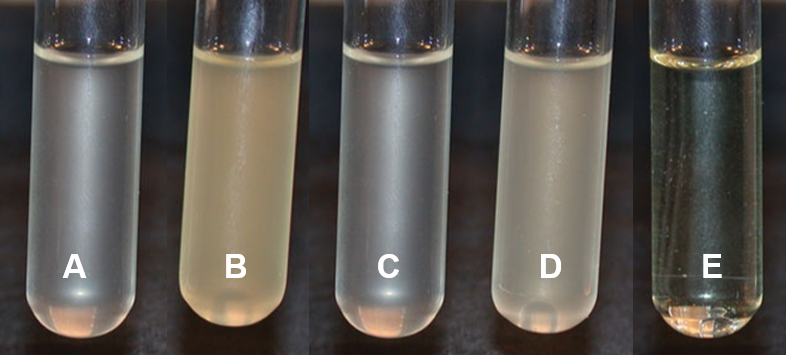
Areas B, C and D are contaminated.A: Patient sample; B: Meat storage; C: Cutting board; D: Food preparation surface; E: Sink. Website: Modified from: chrome-extension://efaidnbmnnnibpcajpcglclefindmkaj/https://www.fbioyf.unr.edu.ar/evirtual/pluginfile.php/108402/mod_resource/content/1/Cap%205%20Brock.pdf
Dr. Spencer: Alright, let's talk about the observations you've made with the liquid cultures. What have you noticed regarding turbidity? Sam: I've noticed that cultures from areas B, C and D are quite turbid, which I think is a clear sign of potential contamination. The patient sample (A) is also turbid, suggesting that the patient symptoms are due to a bacterial infection. You: That makes sense, Sam. Turbidity does suggest the presence of bacteria—possibly even a pathogen. We can't rely solely on turbidity though to accurately gauge bacterial load. Dr. Spencer: Exactly. Turbidity gives a general indication that bacteria are present, but it doesn't provide precise information about the microbial load. Different bacteria can grow at rates that produce varying degrees of turbidity, even at similar concentrations. Turbid cultures should indeed prompt further investigation. We need to understand the bacterial load and whether it is at a hazardous level. Sam: What about sample E, Dr. Spencer? Dr. Spencer: Although this looks clear, we can’t rely on this observation. We should test this sample as well. You: I see, yes, that sounds reasonable. |
Map: CS11 - MICROBIAL CULTURE AND GROWTH (1052)
|
||
|
Review your pathway |