Option 3

Prof. Wilson: Well-done! This is correct! Remember that a substrate is the specific reactant molecule upon which an enzyme acts. It binds to the enzyme's active site, where the chemical reaction occurs. The active site is the region on an enzyme where the substrate binds. It is typically a pocket or groove on the enzyme's surface and facilitates the conversion of the substrate into the product. The active site contains specific amino acid residues that interact with the substrate. Finally, a product is the molecule or molecules that result from the enzymatic conversion of the substrate. It is released from the enzyme after the reaction is complete. Who can give me an example?

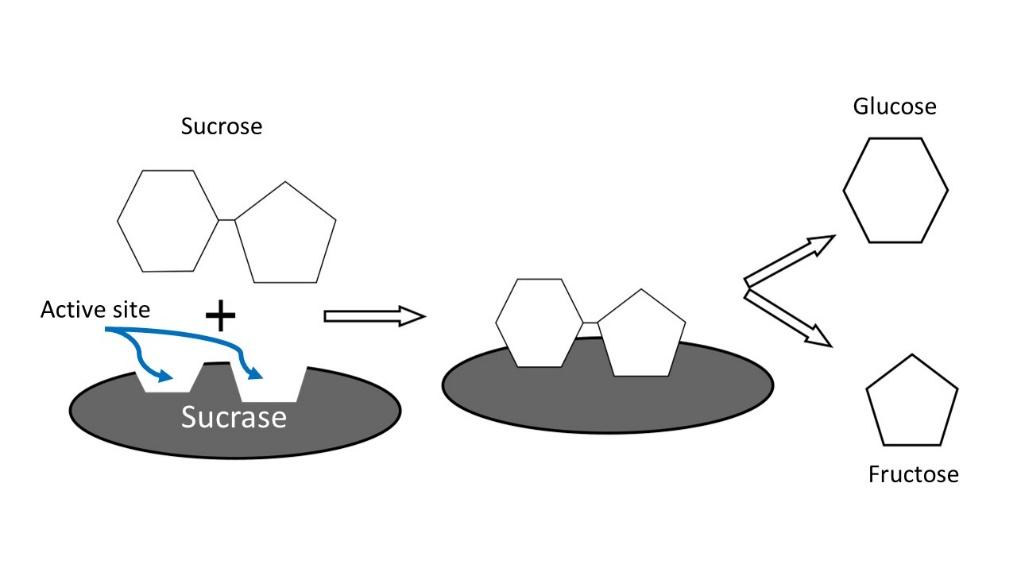
James: I remember the enzyme sucrase, which catalyzes sucrose, which is the substrate.  

You: That’s right, water is also utilized in the reaction, and fructose and glucose are the products of the reaction. The active site on the sucrase enzyme is specific for sucrose and no other substrates have the molecular structure to allow binding. 


Breakdown of sucrose (substrate) to fructose and glucose (product) catalysed by sucrase.

Website: https://commons.wikimedia.org/wiki/File:Sucrase.svg

You: Prof., how fast can an enzyme catalyze a reaction?

Prof. Wilson: Good question! Some key factors can affect the activity of the enzyme. Let’s see if you remember what we talked about in class this week.


Which factor can increase enzyme activity?

  • Increasing the product concentration
  • Increasing the substrate concentration
  • Increasing the temperature and the pH

Map: CS6 - METABOLISM OF CELL ENZYME (PH/TEMPERATURE)_ES (1004)
Node: 18875
Score:

reset

OpenLabyrinth
OpenLabyrinth is an open source educational pathway system

Review your pathway

  • Αποτελέσματα από τις υγρές καλλιέργειες.
  • Κυστική Ίνωση: Θέτοντας το Πλαίσιο
  • Interphase, prophase, prometaphase, metaphase, anaphase, telophase
  • Verapamil (calcium channel blocker)
  • Καλλιεργητικό Υλικό (Culture Media)
  • Amlodipine (calcium channel blocker)
  • So sad
  • Descrierea 1
  • Isosorbite mononitrate
  • Fir de păr
  • 37 °C, niveles atmosféricos de O₂, 5 % de CO₂.
  • Isosorbide mononitrate
  • EMB
  • Probele B, C și D sunt contaminate
  • D
  • Ankle oedema
  • Απάντηση 2
  • Oul de broască
  • To protect us from any spills. White is a colour where most spillages are visible depending solution colour
  • Node 10: Move to scheduling follow-up sessions
  • Afterload
  • Idaruzimab (monoclonal antibody)
  • MAC
  • I don’t see you follow my instruction, do you not want to lift your left arm?
  • Descrierea 3
  • Bisoprolol
  • Node 9: Reassure her receive continuous supportw node
  • Toate zonele testate sunt contaminate
  • Απάντηση 1
  • Ask the patient to walk or change position (risk of falling).
  • Verapamil
  • Karyotype Results
  • Vitamin K
  • E
  • Spironolactone
  • State that assessment cannot continue without a clear image
  • Spironolactone (aldosterone/mineralocorticoid receptor antagonist)
  • A
  • Ask the patient to take a clear photo of the wound (10–15 cm distance, adequate lighting) and upload it to the app
  • Heart rate
  • how do you feel trying to lift your left arm, is it difficult?
  • Cough
  • Amlodipine
  • Empagliflozin
  • Genotype and Phenotype
  • Bisoprolol (beta blocker)
  • Switch to audio + chat mode and promise a PDF summary afterward
  • Option 3

Reminder

empty_reminder_msg

FINISH

Time is up